

Professor Chang Peng’s research group at the School of Biomedical Engineering, ShanghaiTech University, has achieved a series of advances in the field of ultrasound instrumentation development. Two research findings were published respectively in Measurement, an authoritative journal in the field of instrumentation, and Ultrasonics, an authoritative journal in the field of ultrasound. One study reports a stretchable Doppler ultrasound patch for continuous blood flow monitoring. The patch is thin, lightweight, soft, and capable of maintaining stable contact with the skin during daily activities, with the potential to advance blood flow monitoring—previously dependent on hospital equipment and professional operation—toward more convenient long-term home-based health management scenarios. The other study proposes a flexible skull-conformal aberration-corrected phased array (F-SCAPA), offering a new approach for non-invasive, craniotomy-free, and precise brain-targeted therapy for brain diseases.
A Stretchable Doppler Ultrasound Patch Brings Continuous Blood Flow Monitoring Toward Wearable Applications
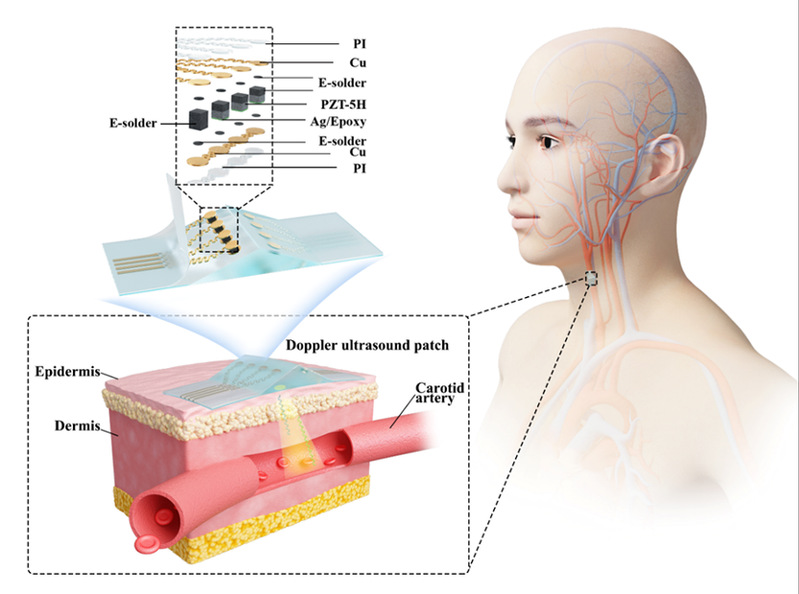
Figure 1 Structural Diagram of the Stretchable Doppler Ultrasound Patch and Exploded View of the Ultrasound Transducer
Blood flow velocity is an important indicator for cardiovascular assessment, but existing monitoring methods have clear limitations. Invasive monitoring provides stable signals but carries risks of trauma and infection, making it unsuitable for long-term use. Common non-invasive Doppler probes require handheld positioning, are relatively bulky, and depend on operator experience. They are also prone to displacement during walking or joint movement, making truly continuous measurement difficult. By integrating flexible electronics with structural design, the research team developed a patch-based system with a core area of approximately 2 × 4 cm and a weight of about 2 g, shifting monitoring from “short-term, fixed-point, operator-dependent” use toward “long-term, wearable, body-conformal” application.
Structurally, the patch adopts a symmetric arrangement of six transducer elements integrated into a flexible substrate with a preset 30-degree tilt angle. After attachment, it forms a stable 60-degree incident angle for detecting subcutaneous blood vessels, reducing errors caused by angle changes during wearing and improving measurement accuracy and repeatability. The patch also exhibits good conformability, with a maximum stretchability of approximately 30%, allowing it to adhere to the skin and curved joint regions while maintaining relatively stable coupling and signal quality.
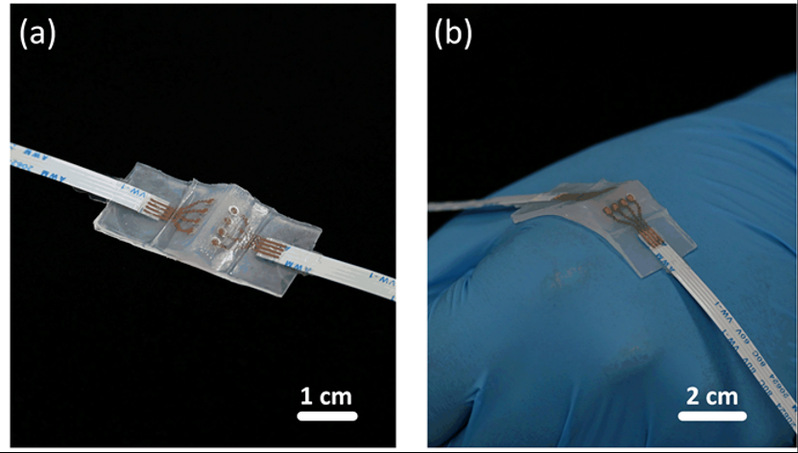
Figure 2 Physical Demonstration of the Stretchable Doppler Ultrasound Patch
In terms of fabrication, the research team simplified the process for preparing serpentine electrodes, reducing steps such as traditional copper/polyimide transfer printing and spin coating, thereby lowering processing complexity and improving the feasibility of stretchable interconnects. For signal processing, the system uses “slow-time sampling” instead of traditional quadrature demodulation, reducing computational cost while extracting Doppler frequency shifts and reconstructing blood flow velocity. Experimental results showed an error of 4.1%–12% within the range of 20–100 cm/s, with clear capture of pulsatile flow waveform changes, covering the typical velocity ranges of major vessels such as the carotid artery.
The research team noted that this stretchable Doppler ultrasound patch provides a new technical pathway for early screening and long-term follow-up of cardiovascular-related diseases. As wearable continuous monitoring further advances toward stability, comfort, and ease of use, daily health management and risk warning at the individual level are expected to gain more real-time, life-integrated blood flow information support.
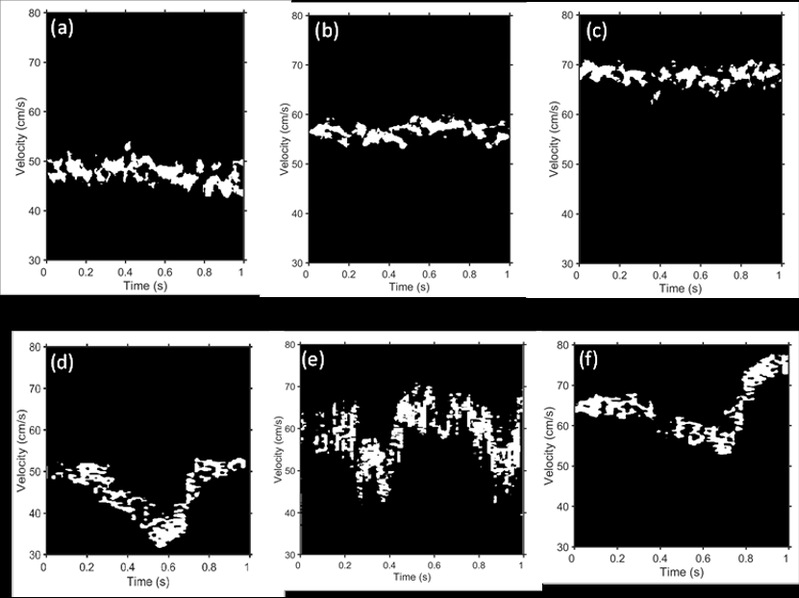
Figure 3 Blood Flow Velocity Measurement Results of the Stretchable Doppler Ultrasound Patch
Master’s student Yuanlong Li from the School of Biomedical Engineering at ShanghaiTech University is the first author of the paper, and Professor Chang Peng is the corresponding author. ShanghaiTech University is the primary institution.
Paper title: A stretchable wearable Doppler ultrasound patch for continuous vascular monitoring
Paper link: https://doi.org/10.1016/j.measurement.2026.120490
A Flexible Skull-Conformal Ultrasound System Provides a New Solution for Precise Brain-Targeted Therapy Without Craniotomy
Transcranial focused ultrasound holds important application prospects in neuromodulation, blood-brain barrier opening, and targeted drug delivery. However, conventional rigid devices have difficulty conforming to the complex curvature of the skull and are easily affected by the acoustic heterogeneity of the skull, leading to focal shift and energy attenuation, which limits treatment precision and application comfort.
To address this issue, the research team developed an 8 × 8 flexible piezoelectric array ultrasound patch with a center frequency of 0.5 MHz. The device demonstrates good mechanical flexibility and electrical stability, can conform to head surfaces with different curvatures, and achieves a maximum tensile strain of 60%, showing good wearable adaptability.
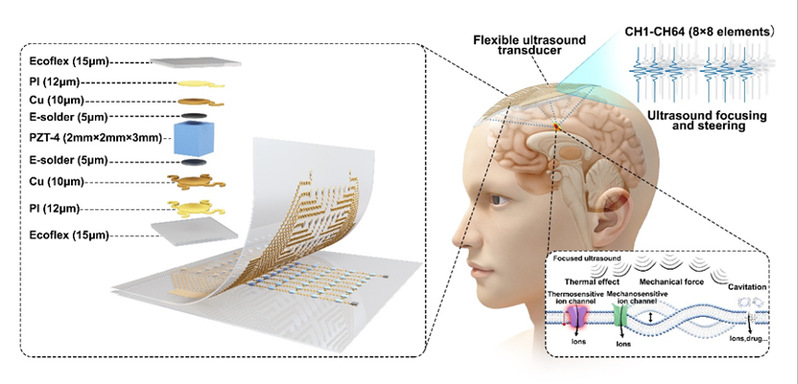
Figure 4 Schematic Illustration of the Structure and Working Principle of the Flexible Skull-Conformal Aberration-Corrected Phased-Array Ultrasound System
On this basis, the team integrated CT-based skull modeling, time-reversal acoustic-field correction, and 3D camera positioning technology to establish an individualized aberration correction strategy. Experimental results showed that the system achieved focused ultrasound at a depth of 36 mm in a human skull model, with an axial full width at half maximum of 8.9 mm. Compared with the uncorrected condition, focal shift was significantly improved, and peak acoustic pressure increased by approximately 30%. Meanwhile, the system also supports multi-focus generation and dynamic focusing, demonstrating strong application flexibility.
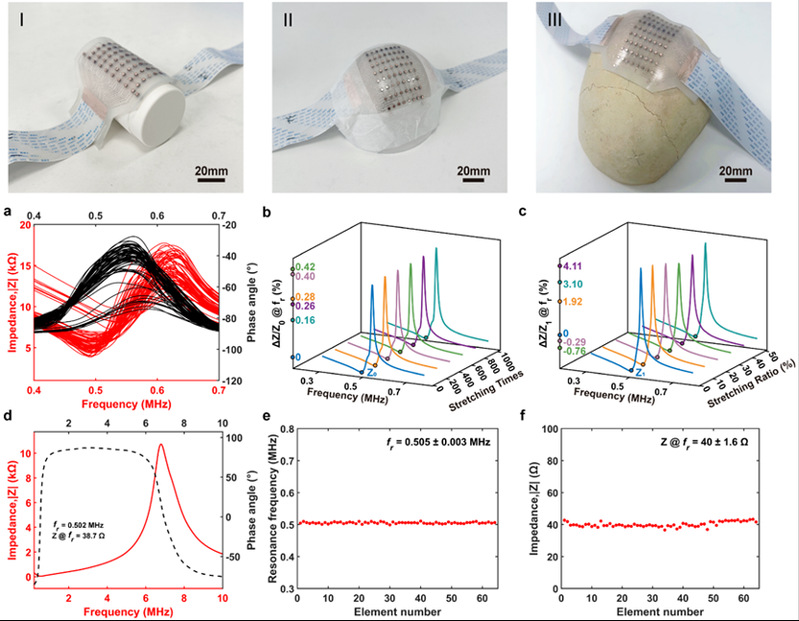
Figure 5 Performance Test Results of the Flexible Skull-Conformal Aberration-Corrected Phased-Array Ultrasound System
This study expands new directions for the application of flexible ultrasound devices in brain science and biomedical engineering, while also providing a technical foundation for the development of wearable, reusable, non-invasive transcranial ultrasound therapy systems.
Jiayi Zhang, a 2022 master’s student from the School of Biomedical Engineering at ShanghaiTech University, is the first author of the paper; Yu Hu, a 2024 master’s student, is a co-first author; Professor Chang Peng is the corresponding author; and ShanghaiTech University is the primary institution.
Paper title: Flexible skull-conformal phased array for aberration-corrected transcranial focused ultrasound therapy
Paper link: https://doi.org/10.1016/j.ultras.2026.108089
