

On March 30, Professor Qian Wang’s research group from the School of Biomedical Engineering at ShanghaiTech University, in collaboration with Huashan Hospital affiliated with Fudan University and other institutions, published a research article online in the renowned Nature Portfolio journal npj Digital Medicine (IF=15.1) titled “A unified deep learning framework for cross-platform harmonization of multi-tracer PET quantification in neurodegenerative disease.” Addressing the issue of differences in PET quantitative results across imaging platforms, the study developed a unified, anatomy-guided deep learning framework that enables cross-platform quantitative harmonization of multi-vendor, multi-tracer PET-MRI data, aligning them with PET-CT quantitative results and providing technical support for the clinical mutual recognition of cross-platform PET quantification.
PET imaging is a key tool for the diagnosis and treatment monitoring of neurodegenerative diseases such as Alzheimer’s disease. However, PET quantitative values are affected by factors including differences in imaging platforms, which limits the direct application of diagnostic thresholds across devices and comparisons across research centers. The framework proposed in this study addresses this challenge through three major architectural innovations: first, it uses a Vision Transformer-based autoencoder to learn CT attenuation features; second, it aligns MRI features to the CT space through contrastive learning; and finally, it performs attention-guided residual correction. This design enables the model to capture generalizable platform-related physical differences rather than fitting tracer-specific patterns.
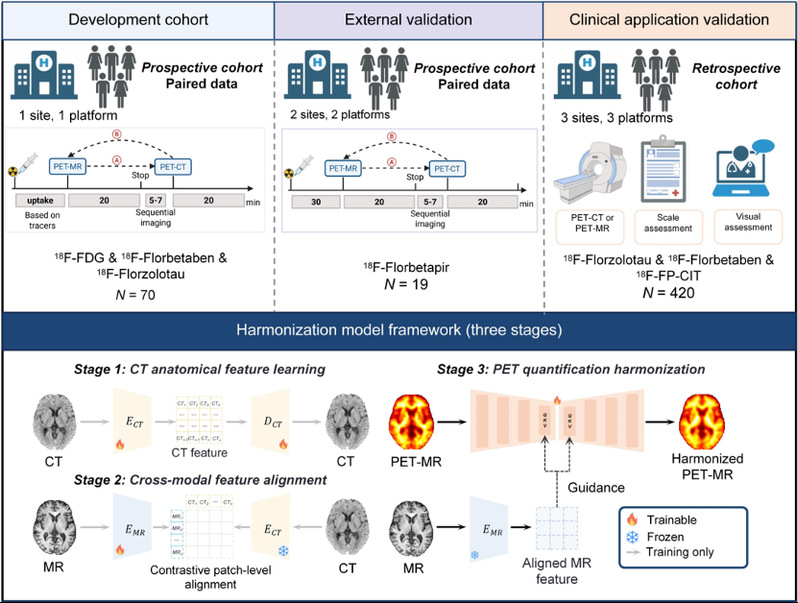 Data Acquisition Workflow and Three-Stage Correction Framework
The research team used 70 same-day paired PET-CT and PET-MR scans covering three tracers—18F-florbetaben, 18F-FDG, and 18F-florzolotau—for five-fold cross-validation training and testing. The results showed that the framework reduced cross-platform quantitative bias by more than 80% while preserving key biological topological associations across brain regions. Importantly, without retraining, the framework was able to achieve “zero-shot” generalization to entirely new tracers unseen during training, namely 18F-florbetapir and 18F-FP-CIT. A multicenter clinical validation study involving 420 participants across three centers and four vendor platforms further demonstrated that, after standardization using this framework, inter-platform differences in amyloid Centiloid values decreased from 23.6 to 4.1, approaching the test-retest variability range of PET-CT itself, and the diagnostic threshold for tau SUVR was highly aligned with the PET-CT standard.
This study establishes a practical pathway for achieving cross-platform, multi-tracer quantitative consistency between PET-MRI and PET-CT. It will help promote the broader clinical and research application of lower-radiation-dose PET-MRI, support reliable longitudinal monitoring when patients switch across devices during treatment, and provide key technical support for integrating different imaging platforms in multicenter clinical trials.
Professor Qian Wang from the School of Biomedical Engineering at ShanghaiTech University, Professor Chuantao Zuo from Huashan Hospital affiliated with Fudan University, and Associate Chief Physician Huiwei Zhang are the co-corresponding authors of this paper. Master’s student Aocheng Zhong and PhD student Haolin Huang from the School of Biomedical Engineering at ShanghaiTech University, together with Dr. Jing Wang and Dr. Qian Xu from Huashan Hospital affiliated with Fudan University, are the co-first authors. Professor Dinggang Shen of ShanghaiTech University and his team also contributed to the collaboration.
Paper link: https://doi.org/10.1038/s41746-026-02570-0
