

Yiming Wu is a 2023-entry undergraduate student at the School of Biomedical Engineering. In his sophomore year, he joined Professor Xuejun Qian’s research group to conduct research on intelligent diagnosis using multimodal imaging. In February 2026, he published related work on low-dose CT-based “one-scan, multi-screening” in Nature Health as a co-author. During his studies, he won the Third Prize in the Shanghai Division of the Contemporary Undergraduate Mathematical Contest in Modeling.
My Journey of Exploration
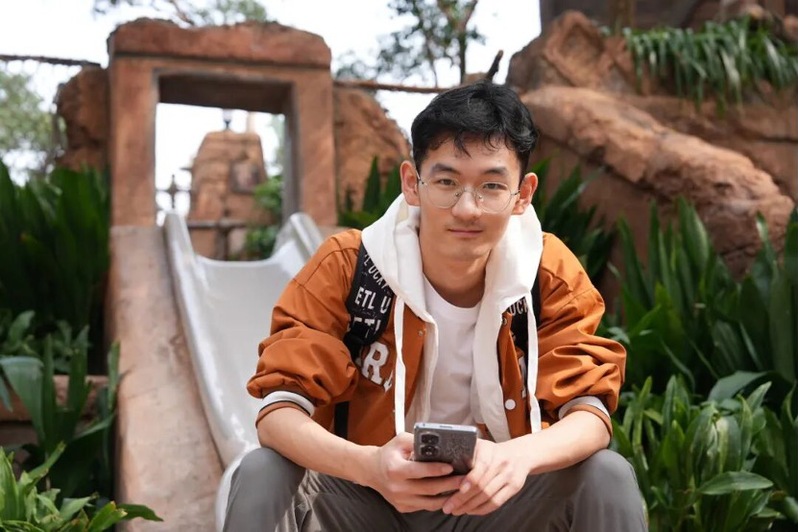
Thanks to the school’s strong research atmosphere and its excellent conditions that make all research equipment available to undergraduate students, I began learning about the research directions of different faculty members and the skill requirements for undergraduate students joining their groups through research group introduction sessions organized by the school starting from the second semester of my freshman year. However, finding where my own interests lay was not a smooth process.
At the beginning of the first semester of my sophomore year, I began consciously reaching out to professors whose research groups interested me. Yet I felt lost about how to introduce myself to faculty members, how to present my research interests and abilities, and whether I could meet their expectations or truly adapt after joining a group. At first, I repeatedly browsed the research group introductions on the school’s website and searched for information on my own, but the information I could obtain was always limited, and I never felt fully reassured. Eventually, I mustered the courage to email the faculty members I was interested in and express my wish to join their groups. However, not every email received a reply. At the beginning, I felt extremely discouraged and thought that I must not be good enough and had failed to join a group. Later, however, I chose to gather my courage again and try contacting different professors. Even when some professors did not reply the first time, after some time had passed, I would combine my new understanding of their research fields with new discussion points and email them again. At the same time, I also seized every opportunity to communicate with professors face to face after class, allowing them to get to know me and helping me experience their styles up close. Through continuous exploration, I gradually clarified that I hoped to further explore the interdisciplinary field of medical imaging and deep learning. Therefore, I chose to join Professor Xuejun Qian’s research group. Fortunately, Professor Qian also recognized my interest and potential in this field. At the end of the first semester of my sophomore year, I successfully joined Professor Qian’s research group and officially began my journey of research exploration.
My Research Life
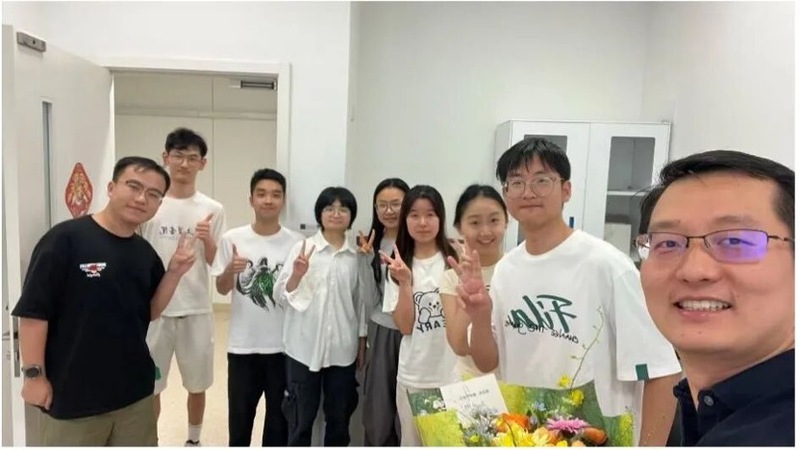
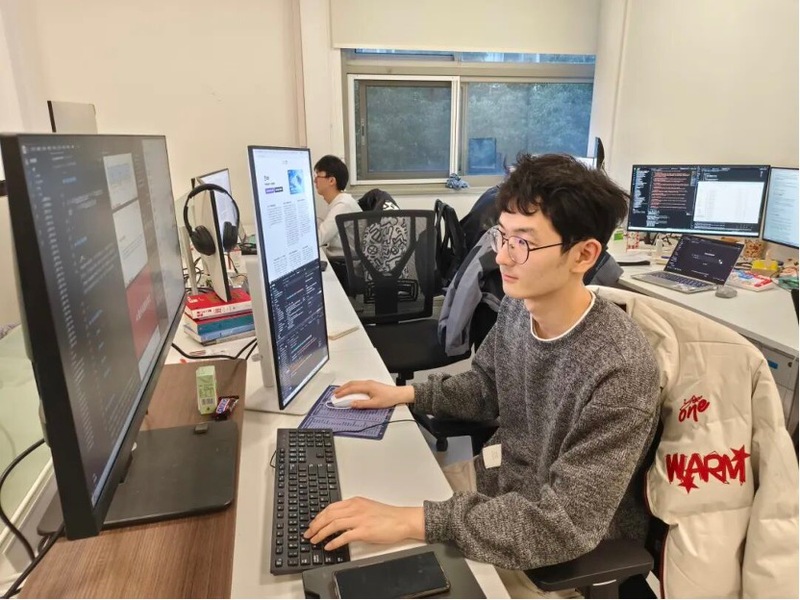
After joining the group, my undergraduate life was no longer limited to classroom learning. Instead, I began to experience the rhythm of graduate-level research in advance. In my spare time, I chose to spend more time in the laboratory and gradually adapted to its research atmosphere. After entering my junior year, I consciously balanced course credits while taking both coursework and research into account. As exam weeks approached, I often completed assignments in the laboratory during gaps when models were training, or discussed course projects with classmates. At the same time, Professor Qian cared greatly about my research progress. He did not overlook me because I was an undergraduate, but gave me guidance on an equal basis and assigned feasible research projects according to my abilities. With the help of my advisor and senior labmates, I began my research journey by reproducing a paper on multi-disease diagnosis. After successfully reproducing the work, I started focusing on using deep learning methods to predict multiple diseases and took on a new project—screening for two types of cancer based on CT images.
To be honest, research was not exactly what I had imagined. During the project, when facing hundreds or even thousands of datasets that needed to be repeatedly checked and screened, I also felt confused and questioned whether the work in front of me truly resembled the image of a scientist I once had in mind. But looking back on this experience, I gradually came to understand that every mature and ambitious project must be rooted in practical, rigorous, and truth-seeking foundational work, and requires persistent meticulousness in the smallest details. Those seemingly tedious repetitions and refinements are an inevitable part of the beginning stage of research. Steady effort over time brings lasting achievement—looking up at the stars while keeping one’s feet on the ground is the true nature of research.
As I became increasingly familiar with the key points of data preprocessing, the complementary advantages of multimodal data, model interpretability, and performance optimization strategies, I gradually came to appreciate the appeal of intelligent medicine. Eventually, after more than half a year of peer review, our research was successfully accepted by Nature Health. Looking back on this journey, I deeply realized that real research is a long journey accompanied by failure and perseverance. Only by firmly walking through those seemingly ordinary and tedious days, accumulating progress bit by bit, can one finally reach a truly shining moment.
My Research Outlook
In the future, I hope to continue delving deeper into the field of deep learning and pay greater attention to the implementation of deep learning models in clinical scenarios. I will strive to understand the real needs of patients, focus on the current diagnostic and treatment challenges faced by various chronic diseases and cancers, and begin with AI-assisted diagnosis for physicians to gradually explore how technology can truly serve clinical practice. Born at the right time and living in the age of AI, I hope to contribute my modest efforts to bringing even a glimmer of light and hope to all those suffering from illness around the world.
Conclusion
From firmly choosing biomedical engineering as my major, to finding my own area of interest within two years, working hard for it, and achieving results, this experience has taught me that university is not a brief dawn after crossing a narrow bridge with thousands of others, but a brand-new starting point in the long race of life. Within these limited four years, we encounter all kinds of opportunities, challenges, and even regrets, and it is precisely these moments that piece together the truest picture of university life. They have also helped me gradually understand that the meaning of university does not lie in pursuing a perfect trajectory, but in trial and error, exploration, and coming to know oneself step by step.
What I Want to Say to Junior Students
On the stage of infinite possibilities that is the School of Biomedical Engineering at ShanghaiTech University, every undergraduate’s four years contain a brilliance of their own. Bravely taking the first step is the starting point for reaching a higher platform. True growth does not lie in making a right or wrong choice once and for all, but in the persistence, reflection, and continuous improvement that follow after a choice is made and difficulties arise. Only in this way can we grasp our own direction in this era full of change. May we continue to work hard every day and every moment of our university journey, so that one day in the future, the school will be proud of us.
