

On March 11, Dinggang Shen’s team from the School of Biomedical Engineering at ShanghaiTech University published a research article titled “BrainParc: Unified Lifespan Brain Parcellation from Structural Magnetic Resonance Images” in the leading international academic journal Nature Computational Science (impact factor: 18.3). The study proposes a new method for brain tissue segmentation and brain region parcellation across the entire lifespan, providing powerful technical support for large-scale brain imaging analysis and neuroscience research.
Brain Tissue Segmentation and Brain Region Parcellation Across the Lifespan
Automatically and accurately segmenting brain tissues and brain regions from structural magnetic resonance imaging (sMRI) is an important foundation for studying brain development, conducting neuroimaging analysis, and supporting clinical diagnosis. However, during brain development and aging, significant differences exist in brain morphology and MRI signal characteristics, while variations in scanning devices and acquisition parameters further amplify changes in MRI intensity and contrast. These factors lead to a significant decline in the performance of existing methods when applied across populations and datasets, especially at challenging stages such as infancy and early childhood.
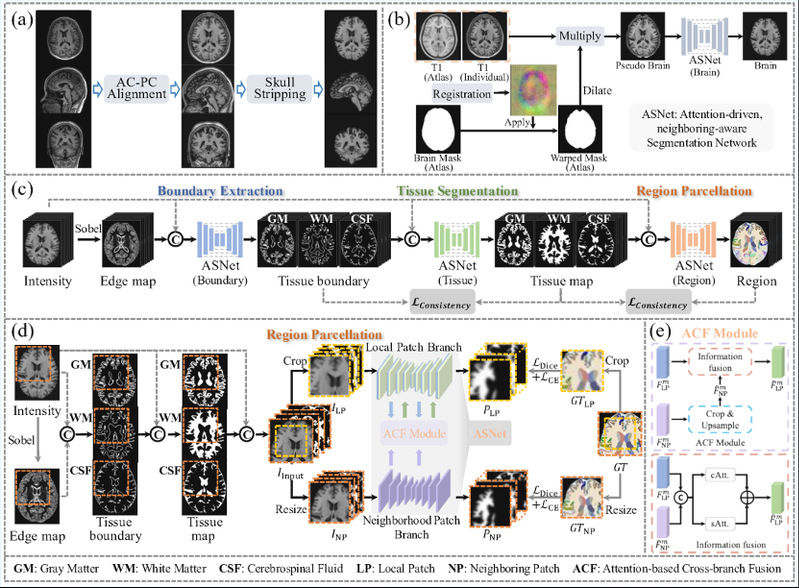
Schematic Illustration of Generalized Lifespan Brain Tissue Segmentation and Brain Region Parcellation
To address these challenges, the research team proposed BrainParc, a unified method for brain tissue segmentation and brain region parcellation across the lifespan. This method introduces brain anatomical structural information that is insensitive to variations in sMRI intensity and contrast, effectively eliminating imaging differences across populations and data centers. As a result, it enables longitudinally consistent brain tissue segmentation and brain region parcellation across the entire lifespan without the need for fine-tuning. The research team systematically trained and validated BrainParc using 93,000 sMRI scans from 19 centers worldwide. Experimental results show that BrainParc outperforms existing mainstream methods overall in the fine-grained segmentation of 106 brain regions. In particular, at the most challenging infant and early childhood stages, BrainParc demonstrated stable and consistent segmentation performance in both quantitative metrics and visual results.
Leveraging BrainParc’s powerful capabilities in brain tissue segmentation and brain region parcellation, the research team further characterized the volume trajectories of major brain regions across the whole brain throughout the lifespan, systematically revealing the structural evolution patterns of brain volume during development and aging.
This study demonstrates the possibility of advancing brain tissue segmentation and brain region parcellation from “data dependence” toward “true generalization.” It provides a solid foundation for cross-age and cross-center neuroimaging research, while also laying an important technical foundation for the clinical translation of related methods.
Dr. Jiameng Liu, a PhD graduate from Professor Dinggang Shen’s research group at ShanghaiTech University, is the first author of the paper. Professor Dinggang Shen, founding dean of the School of Biomedical Engineering at ShanghaiTech University and Co-CEO of United Imaging Intelligence, and Dr. Feng Shi, Distinguished Research Fellow at ShanghaiTech University and Director of the Shanghai United Imaging Intelligence Research Institute, are the co-corresponding authors. ShanghaiTech University is the lead institution, and the Shanghai Clinical Research Center is a collaborating institution.
Paper link: https://www.nature.com/articles/s43588-026-00963-5
