

Author Profile
Mengjie Xu is a 2023 master’s student in Professor Qian Wang’s research group at the School of Biomedical Engineering, with research interests in object tracking and medical image analysis. As first author, she has published one paper at the IEEE/CVF Conference on Computer Vision and Pattern Recognition (CVPR) and one paper in the journal Biomedical Signal Processing and Control (BSPC). She was also awarded the 2025 National Scholarship for Graduate Students.
As the evening breeze at year’s end brushed past the windowsill of the laboratory building, the year 2025 quietly carved a new mark in time. For me, a 2023 student at the School of Biomedical Engineering, ShanghaiTech University, this year has been a milestone. This year, I shed the uncertainty and tentative steps of my first year as a graduate student and found my own rhythm in the deep waters of research. This year, I not only achieved a breakthrough at a top-tier conference in computer vision, but also received the National Scholarship for Graduate Students in recognition of my solid academic achievements. This weighty honor, together with the CVPR 2025 Highlight recognition, has become an important annotation in my graduate journey.
Research: Tackling the Challenges of Multi-View Tracking
In terms of research, I have mainly focused on multi-view object tracking. At the beginning of the project, we needed to build a complete pipeline, including a series of algorithms for data collection, classification, registration, and annotation. Camera placement and calibration were particularly important. Because multiple scenarios were involved, we had to repeatedly adjust the camera positions, and any issue during data collection could render the videos unusable. Looking back now, however, what comes to mind is no longer the hardship of data collection, but the warm encouragement among teammates. The difficulties of the past have settled with time and become even more precious. The subsequent algorithm design progressed steadily, and by then I had fully adapted to research work. The question of how to conduct multi-view fusion troubled us for a long time. Through continuous discussions with senior students, the collision of ideas gave rise to countless possibilities. Thanks to the computational resources available at the School of Biomedical Engineering, these ideas could be quickly implemented and validated. Discussions with my advisor, Professor Qian Wang, during group meetings also deepened my understanding of these problems, and ultimately led to the design of a multi-view fusion-based object tracking method. I published this work as first author at CVPR 2025, where it received Highlight recognition.
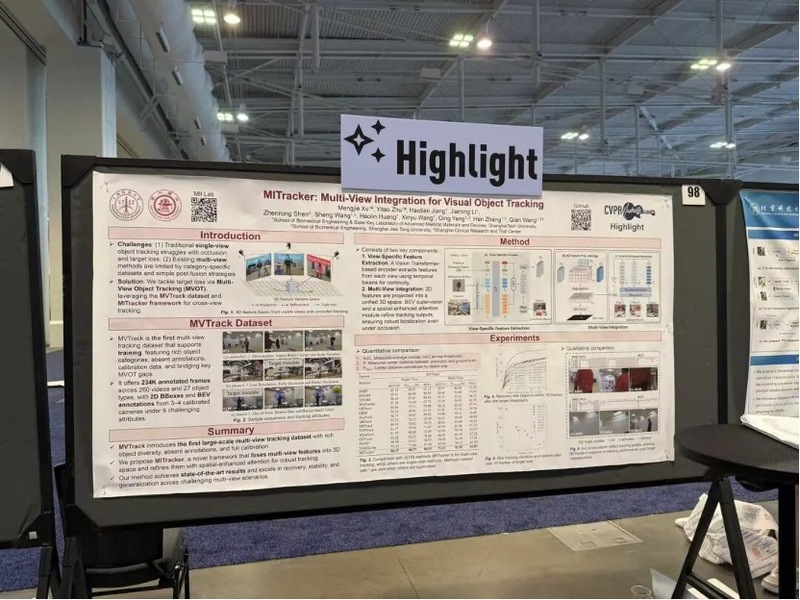
CVPR 2025 Highlight Achievement
Practice: Stepping Beyond Code and Touching Reality
In addition to focusing on algorithms, I also participated in the development of the ShanghaiTech cohort of the “Chinese School-aged Children Brain and Cognitive Development Cohort Study.” Although I was mainly involved in an assisting role, this experience opened a window for me to see another side of research.
I learned the operational procedures of magnetic resonance imaging scans. While assisting with scans, I gained a deep appreciation for the complexity of integrating engineering technology with clinical applications. Previously, I only cared about whether the data I received were clean, but this experience helped me understand the rigor and standardization required behind data acquisition. This shift in perspective—from simply “processing data” to understanding “how data are generated”—was a valuable experience that cannot be learned from textbooks. It also gave me a more practical understanding of “medical-engineering integration.”
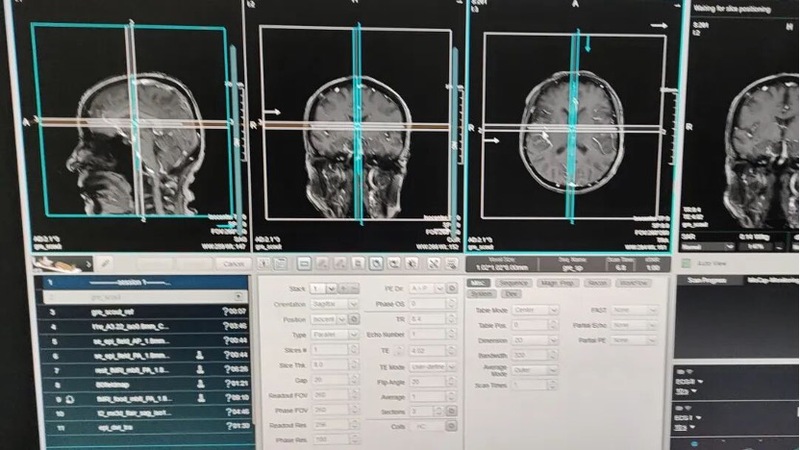
Assisting with the Brain and Cognitive Development Cohort Study
Life: Balancing Tension and Relaxation, Reshaping Myself
Research is not only a contest of intellect, but also a long-distance test of mental strength. The vibrant campus atmosphere at ShanghaiTech always gives me invisible energy when I feel tired.
Sitting in the stands at the university sports meeting and watching students dash across the track, I was deeply inspired by their youthful vigor and spirit. The New Year Gala of the School of Biomedical Engineering, meanwhile, is our own stage for releasing pressure. On that day, everyone temporarily sets aside their burdens and gathers to share complaints, laughter, and joy. This relaxed and cheerful sense of belonging helps us find balance amid the intense pace of research.
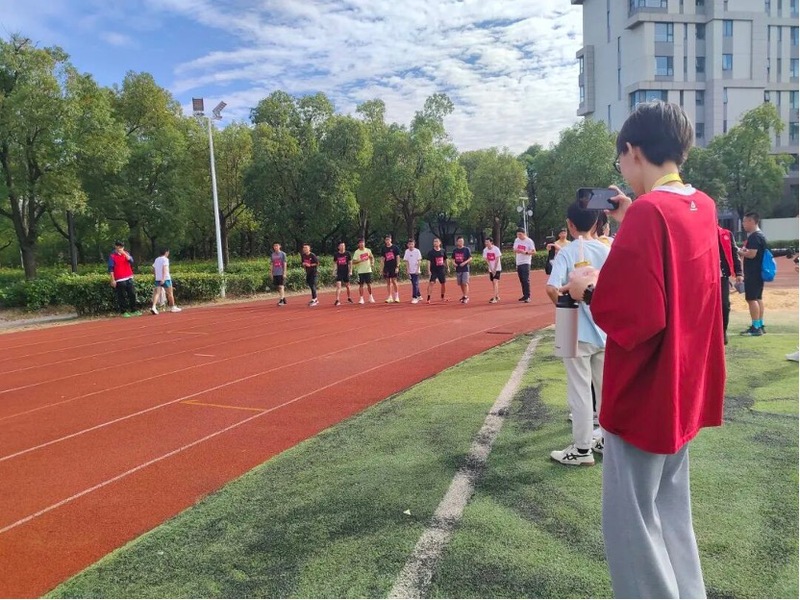
Waiting for the Starting Gun at the University Sports Meeting
Message: Stay Focused and Let Time Bring the Blossoms
I am grateful to the school for providing a powerful computing platform and to my advisor for his attentive guidance, which have enabled my ideas to be rapidly implemented and validated.
In the future, I will continue to delve deeper into the field of multi-view tracking and strive to apply algorithms to more practical scenarios. To junior students, I would like to say: the path of research is long and full of uncertainty, but as long as you stay focused and move forward firmly at your own pace, all your efforts will eventually be seen.
