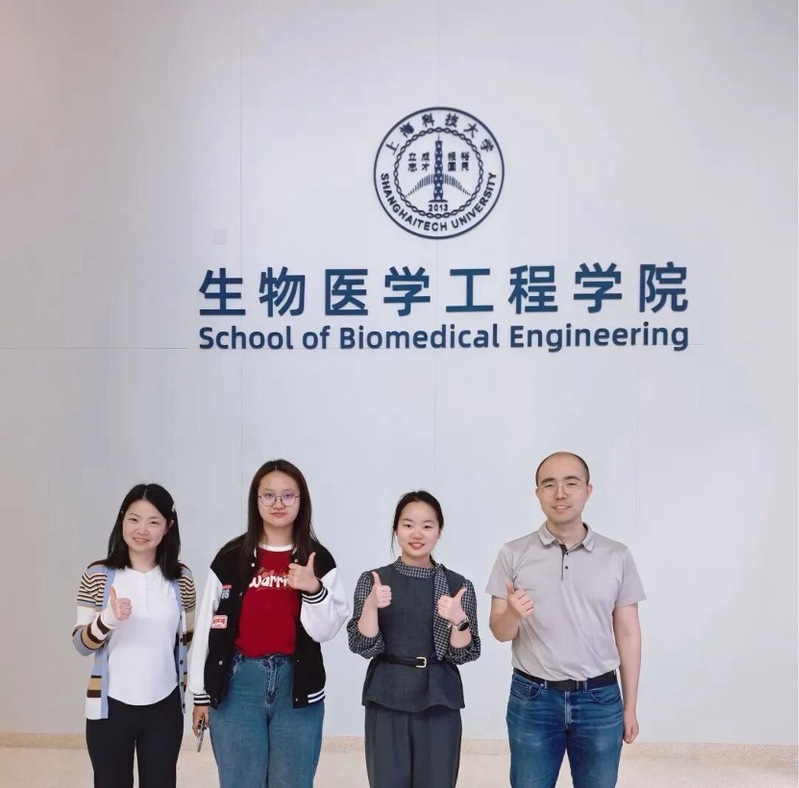
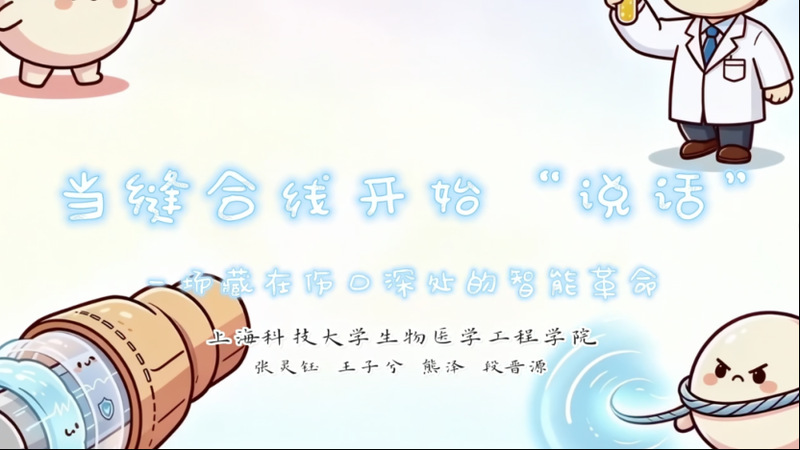
Recently, the 2026 China Biomedical Engineering Science Popularization Micro-video Competition, hosted by the Chinese Society of Biomedical Engineering, successfully concluded. The science popularization animation work “When Sutures Begin to ‘Talk’ — An Intelligent Revolution Hidden Deep Inside Wounds,” jointly created by Lingyu Zhang and Zixi Wang, undergraduate students of the 2025 cohort in Biomedical Engineering at our School, stood out from more than 200 entries nationwide. After multiple rounds of competition, including preliminary review by correspondence, online public voting, and expert panel evaluation, the work ultimately won the First Prize of the competition. It will also be included in the Society’s science popularization resource library for promotion and display.
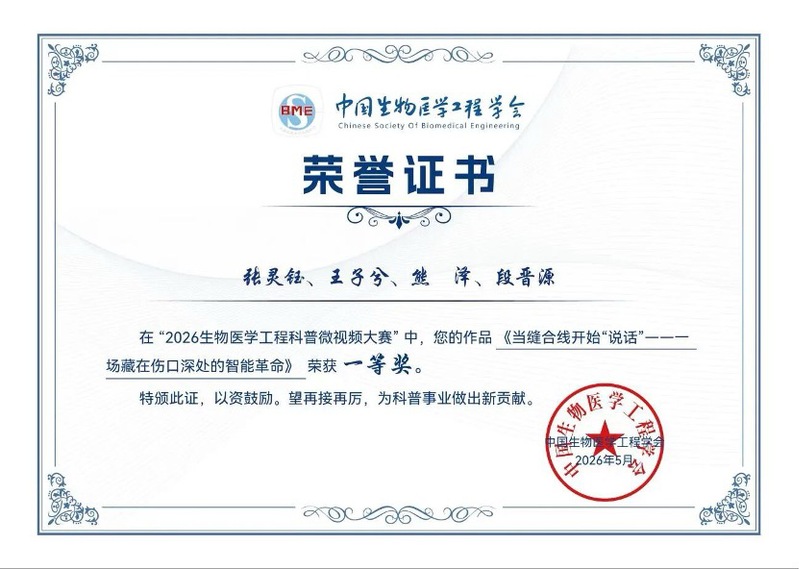
Today, the two students would like to share with everyone the details behind this honor.
A Seed Planted in the Classroom:
First Encounter with Biomedical Engineering and the Beginning of Exploration
When we first entered the campus, we knew very little about the interdisciplinary field of biomedical engineering, and simply understood it as a combination of medicine and engineering. In the course Introduction to Biomedical Engineering last semester, Professor Guohua Cao helped us clear away the fog and truly understand the core of biomedical engineering: it is a bridge that connects cutting-edge technology with life and health, and links research laboratories with clinical bedsides. Systematic coursework made us especially interested in the field of intelligent medical devices. We genuinely experienced the unique charm of medical-engineering integration, and a seed of exploring frontier technologies was planted in our hearts.
Relying on the exploration of the course final project and the School’s strong research atmosphere, we have always maintained enthusiasm for exploring the frontiers of the field. At the School’s “Stars of Tomorrow” research achievement sharing session, we were deeply impressed by the intelligent wireless electronic biological sutures developed by Professor Ze Xiong’s team. Unlike traditional sutures that are only used for wound closure, this intelligent suture can go deep inside wounds to monitor postoperative conditions in real time, becoming an “intelligent sentinel” that safeguards patients’ health. It precisely addresses the clinical pain point that deep wounds are like a “black box” and that postoperative hidden risks are difficult to detect in time, while embodying both technological innovation and humanistic warmth.
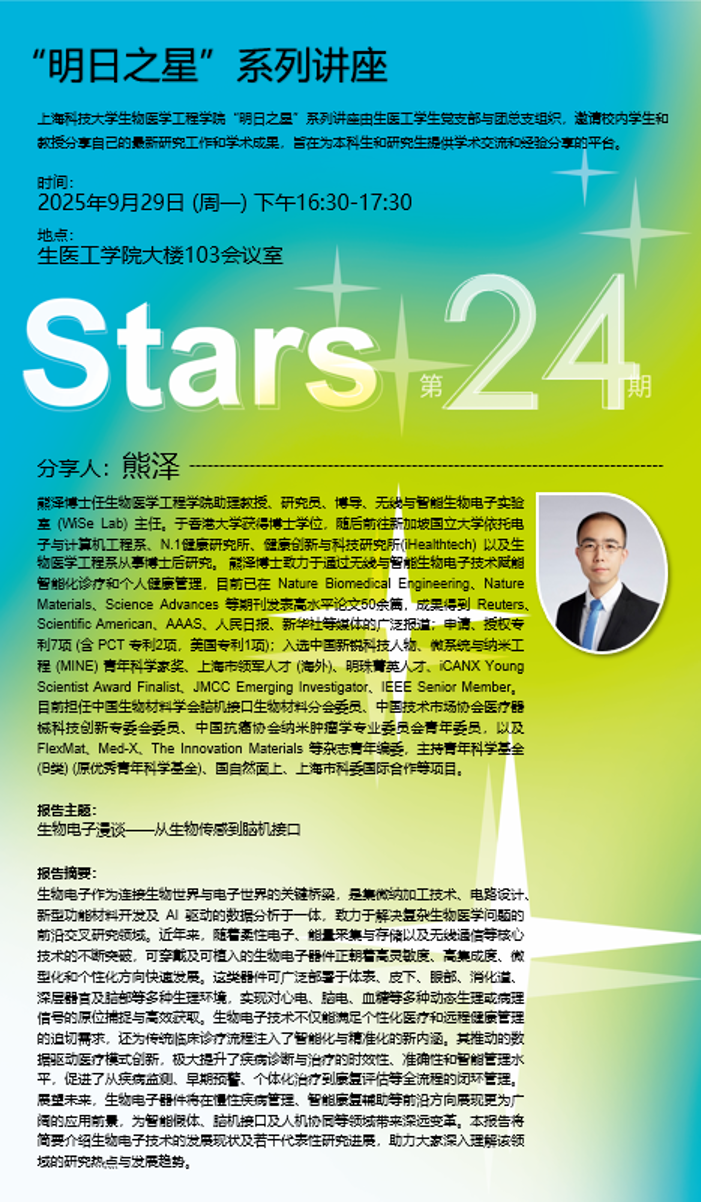
It was precisely this ingenious research achievement that gave us the idea of science popularization. We hoped to explain obscure frontier medical-engineering technology to more people in an accessible way.
Writing Comes First:
Testing the Waters of Science Popularization and Conveying Science Through Words
To do science popularization well, we first had to understand it thoroughly ourselves. Faced with difficult professional terms such as conductive polymers, radio-frequency signals, and Schottky diodes, we, as beginners in the major, felt the challenge deeply. For this reason, we settled down to read the original paper carefully, break down the technical principles, and sort out the core logic. At the same time, we put ourselves in the audience’s position and kept thinking about how to make complex professional knowledge more accessible, so that the general public could also understand the value of this frontier technology.
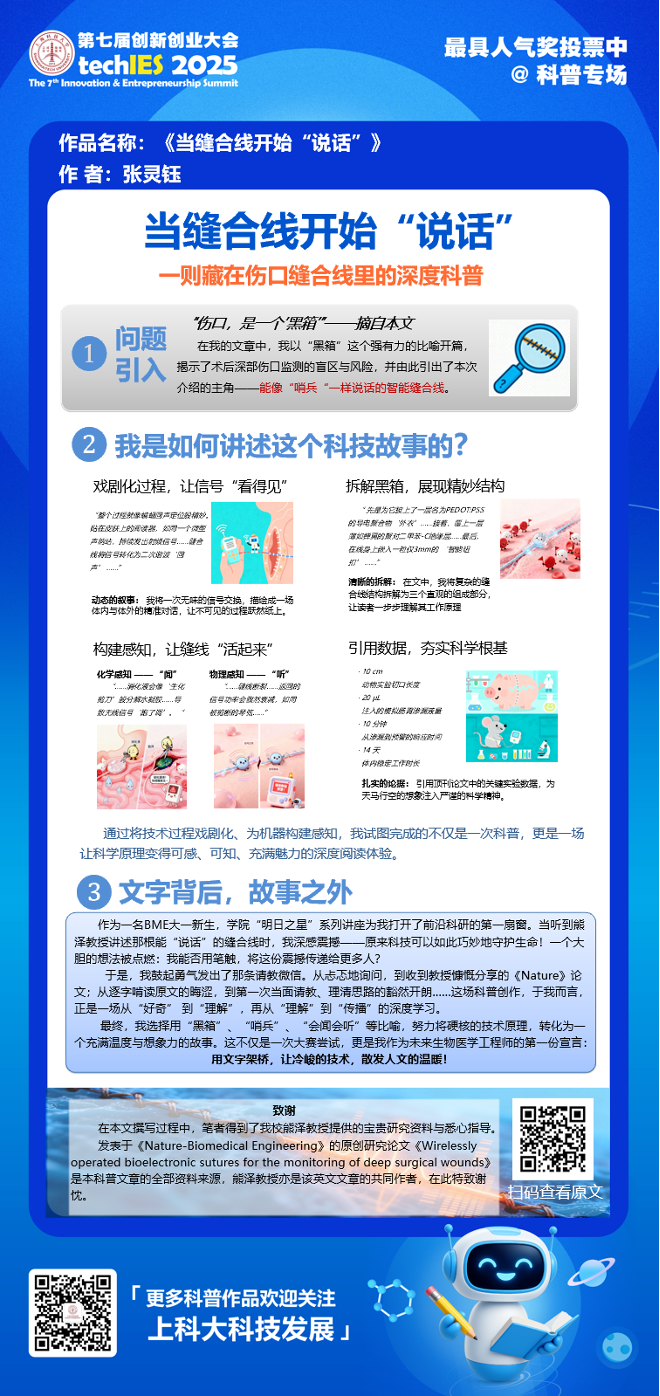
At that time, the university’s Innovation and Entrepreneurship Conference was holding a science popularization special competition. Under the careful guidance and encouragement of Professor Ze Xiong, we put into writing the impact we felt when listening to the research sharing, our understanding of intelligent suture technology, and our professional reflections on biomedical engineering. This sincere and heartfelt science popularization manuscript also became the initial prototype of the science popularization animation work.
The attempt at written science popularization enabled us to successfully complete our first transformation of professional knowledge. However, we also found that static text could not intuitively show microscopic processes such as the internal structure of the suture and the operating principles of wireless sensing. This gave us the idea of making an animation, hoping to present frontier research achievements in a more vivid and three-dimensional form.
Frame-by-Frame Creation:
Turning Words into Animation and Polishing Every Detail
This semester, with the careful guidance and support of Professor Jinyuan Duan, we upgraded the science popularization text into a dynamic animated work and officially registered for the 2026 China Biomedical Engineering Science Popularization Micro-video Competition. From writing to animation production, this was a challenge in which we started from scratch and made a brand-new breakthrough.
To break down professional barriers, we adopted an accessible and personified approach to science popularization: comparing deep wounds to a “black box,” portraying the intelligent suture as a postoperative “intelligent sentinel” on duty 24 hours a day, and using vivid metaphors such as “smelling leakage” and “listening for rupture” to concretize the sensing principles, guiding the audience to understand hard-core scientific knowledge through an engaging narrative.
We strictly upheld scientific rigor, repeatedly checking the technical principles against the paper and related materials, clarifying the mechanisms of signal changes corresponding to wound leakage and suture rupture, and polishing the narration script and metaphorical expressions word by word, so as to avoid knowledge deviations and excessive simplification.
In addition, we unlocked many new attempts, independently completing storyboard script drawing and the animated transformation of scientific research diagrams. With the assistance of AI in image production, we then refined and optimized the work frame by frame. We always adhered to our creative principle: images may be empowered by tools, but scientific content must be independently checked by ourselves. Through division of labor, collaboration, and mutual polishing, we came to understand the meaning of science popularization during the process of creating side by side: with a heart of learning together, transforming professional scientific language into warm expressions that the public can understand.
Advancing Knowledge and Practice Together:
Gathering Strength Through Voting + Learning at the Summit to Broaden Our Vision and Grow Further
The final ranking of this competition was determined by a combination of preliminary review by correspondence, online public voting, and offline expert evaluation. After our work successfully advanced to the final, teachers, students, relatives, and friends from across the university all helped by voting for us. Every bit of support carried recognition and encouragement, and also strengthened our original aspiration to continue deeply engaging in science popularization.
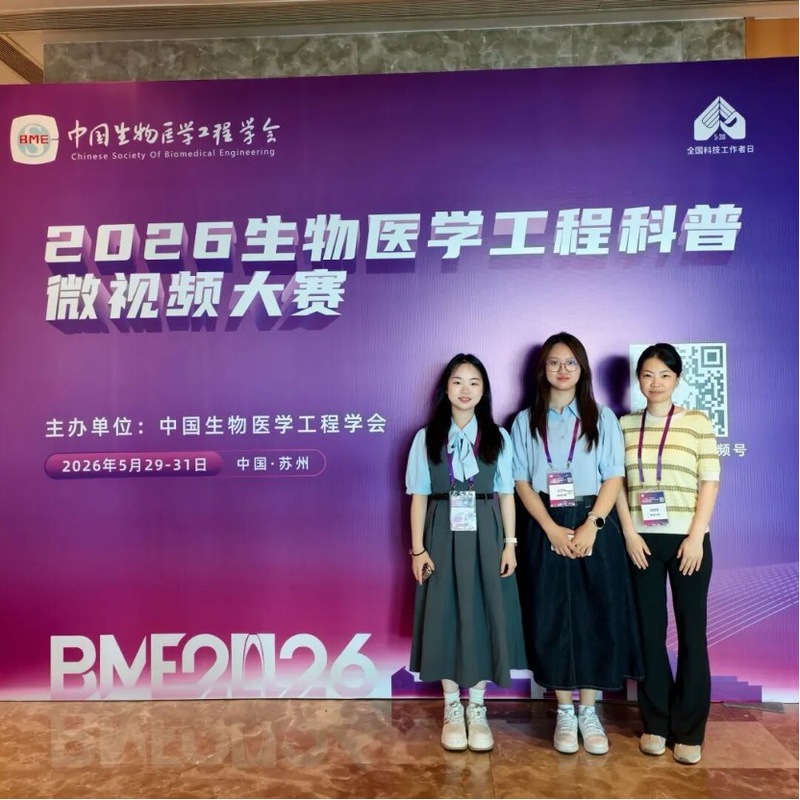
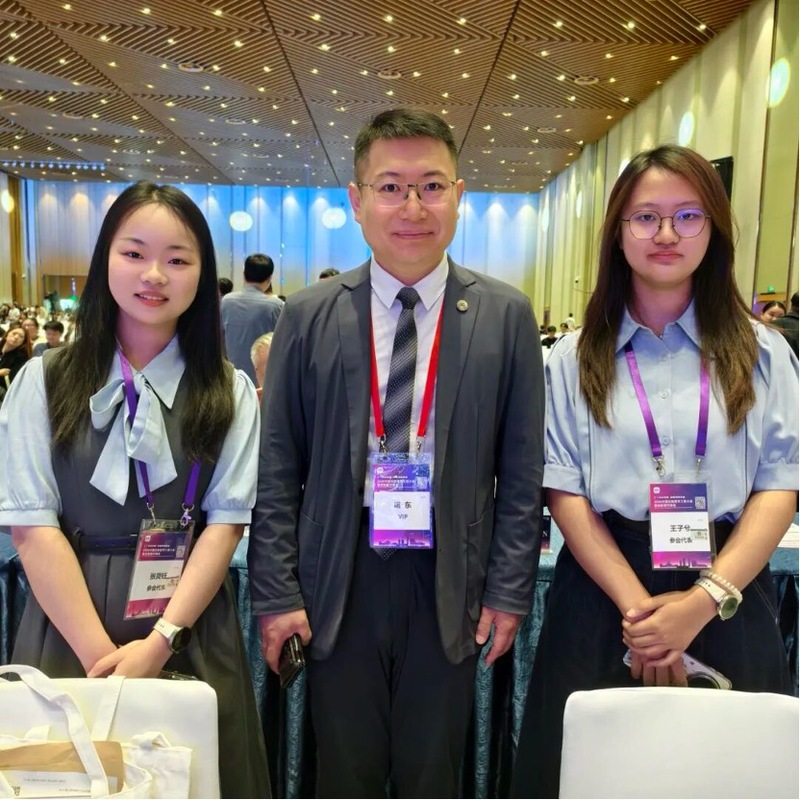
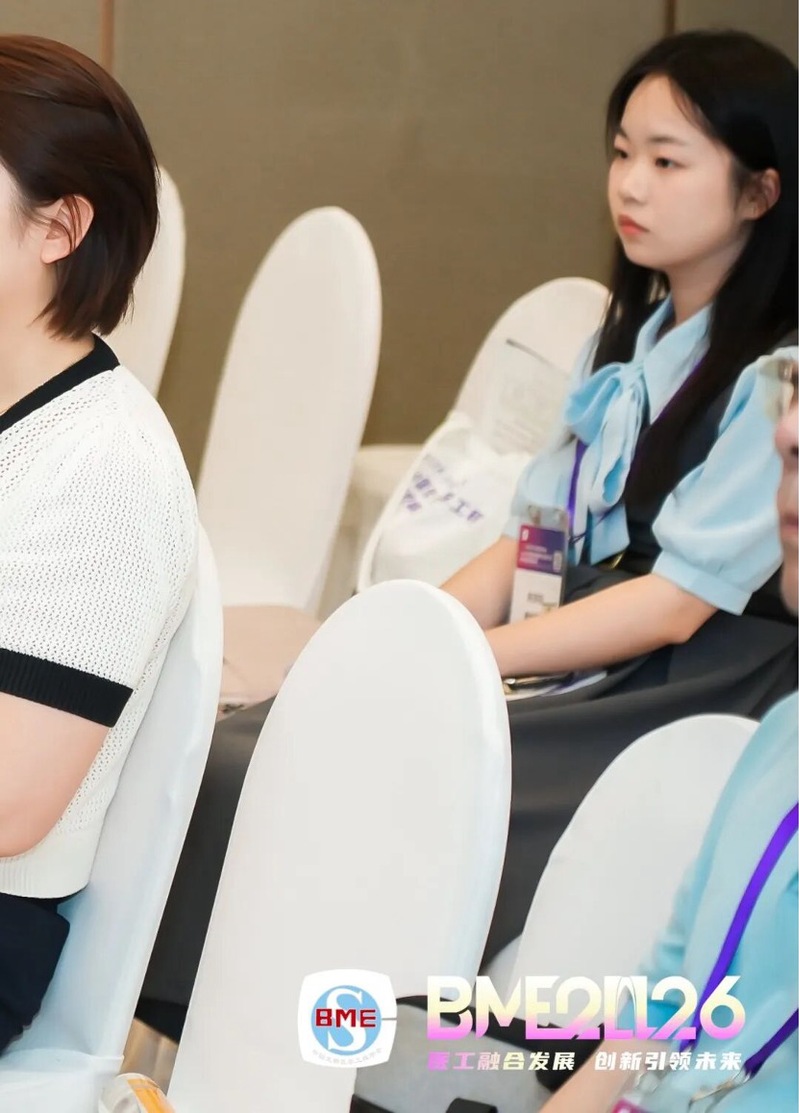
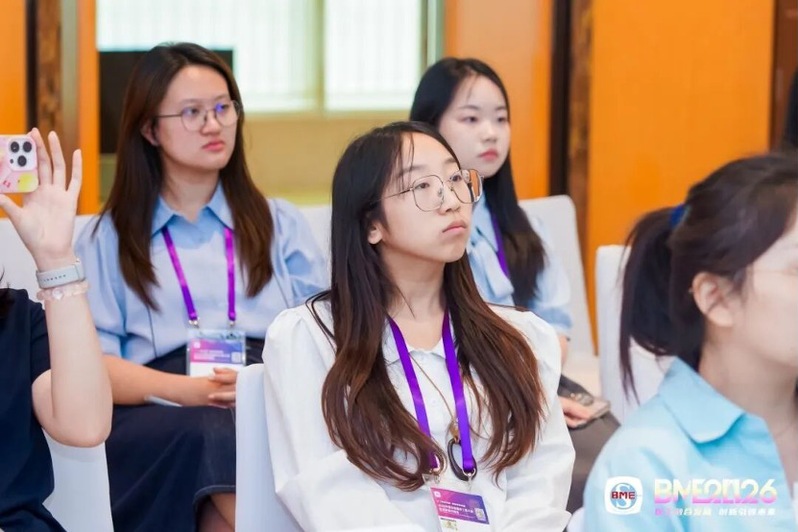
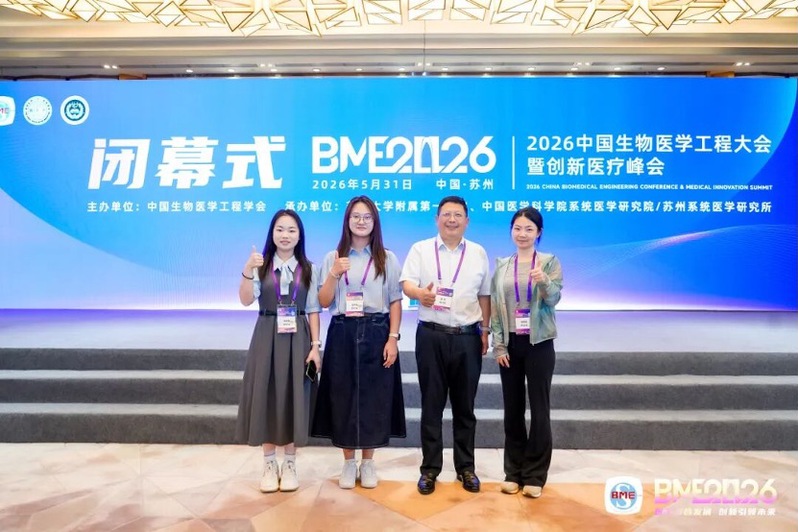
On May 29, we went to Suzhou to participate in the 2026 Chinese Biomedical Engineering Conference and Innovative Medical Summit. At this top-level event in the field, we communicated with experts and teachers in the industry, listened to frontier academic reports, and gained a deeper understanding of the latest industry progress in medical-engineering integration and intelligent medical devices.
The summit learning experience enabled us to step beyond books and the creation process itself, broadening our professional horizons. We deeply realized that biomedical engineering technology should not only be deeply rooted in research and development, but should also be brought into science popularization and value communication. The frontier industry insights also fed back into the refinement of our work, giving us a deeper understanding of the creative core of “technology safeguarding life.”
Returning with Honor:
Using Science Popularization as a Bridge to Interpret the Warmth of Biomedical Engineering
After multiple rounds of evaluation and competition, our work won the First Prize of the competition. For us two first-year students, this honor is not only recognition of our science popularization work, but also tremendous encouragement for our courage to explore and our deep engagement in science popularization.
Looking back on the entire preparation process, we began as students who had just encountered the major in the classroom, and then went through layers of training, including writing a science popularization article, reading scientific research papers, and polishing an animated work. We successfully completed the transformation from knowledge recipients to knowledge communicators, truly internalizing obscure professional knowledge in our hearts and externalizing it through our actions.
We deeply realized that the value of biomedical engineering lies not only in cutting-edge scientific research and innovation, but also in allowing technology to be implemented for the benefit of the people. Science popularization is the warm bridge connecting laboratories and the public, giving warmth to cold scientific research achievements. Just as our work seeks to convey: the suture that can “talk” transmits not only wound-monitoring signals, but also the warm power of technology safeguarding life.
With Gratitude in Our Hearts, We Keep Moving Forward
This honor is made possible by the School’s high-quality education platform and strong research atmosphere. We sincerely thank all teachers and leaders of the School for their careful guidance, and we also thank all teachers, students, relatives, and friends for their support and assistance, as well as every audience member for their recognition.
Winning the award is not the end, but a new starting point for our professional learning and exploration of science popularization. In the future, we will continue to deeply engage in biomedical engineering knowledge, consolidate our interdisciplinary foundation, and focus on frontier technological fields. We will also remain true to our original aspiration in science popularization, spread professional knowledge in an accessible and warm way, tell the story of biomedical engineering well, and demonstrate the original aspiration and responsibility of young students to safeguard health through technology.
A small suture carries the original aspiration of science popularization and the warmth of scientific research. The road ahead is long, and we will keep moving forward without stopping!