

On May 19, the research team led by Dinggang Shen from the School of Biomedical Engineering at ShanghaiTech University published an important study in Nature Biomedical Engineering (Impact Factor: 26.6), a leading Nature Portfolio journal, proposing a new AI-assisted method for the non-invasive diagnosis of breast cancer. The paper is titled “A deep learning system for non-invasive breast cancer diagnosis with multimodal data.”
Breast cancer is one of the most common malignant tumors among women, and early, accurate diagnosis is crucial for improving patient prognosis. Clinically, multimodal imaging is often used for preliminary risk assessment of lesions, followed by needle biopsy to determine pathological characteristics. However, needle biopsy is an invasive procedure that not only increases medical costs but may also add to the physical and psychological burden on patients. Therefore, accurately distinguishing benign from malignant breast lesions based on multimodal imaging and reducing unnecessary biopsies have become key clinical challenges in breast cancer diagnosis.
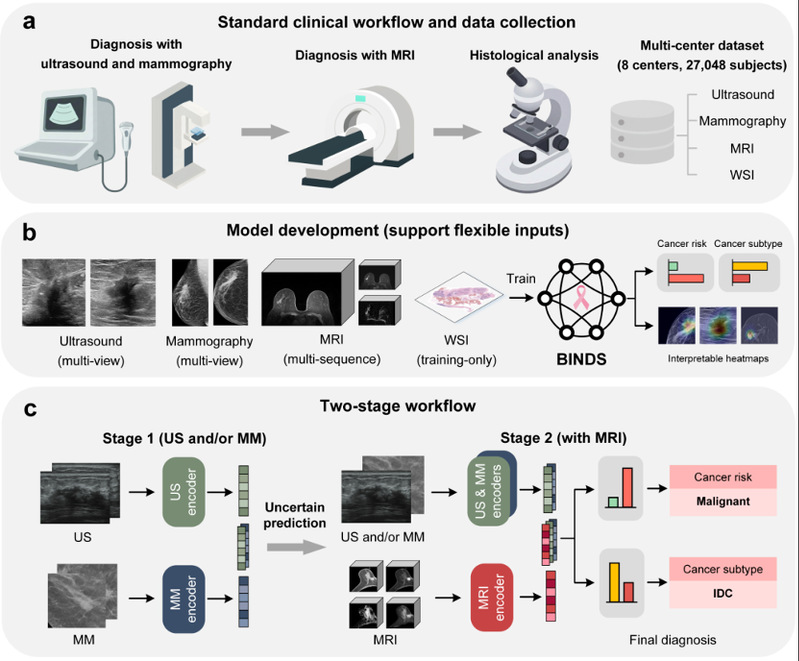
To address this challenge, the research team developed the Breast Cancer Intelligent Non-Invasive Diagnosis System, or BINDS. The system integrates multimodal imaging data, including ultrasound, mammography, and magnetic resonance imaging, to enable risk assessment and subtype classification of breast lesions. BINDS adopts a two-stage diagnostic model aligned with clinical workflows: in the first stage, preliminary assessment is performed using ultrasound and/or mammography; when the result is uncertain, the second stage incorporates MRI information for a more comprehensive multimodal diagnosis, thereby improving diagnostic accuracy in challenging cases while controlling examination costs. In addition, considering that different patients may undergo different imaging examinations, BINDS supports arbitrary combinations of input modalities, giving it strong practicality and adaptability.
This study also introduced a radiology–pathology alignment mechanism. During model training, the system uses pathology whole-slide images as histological references to guide the model in learning key imaging information associated with pathological features, thereby enhancing the diagnostic value of radiological features. In real-world clinical applications, however, BINDS no longer requires pathology images and can complete non-invasive assessment using radiological imaging data alone. In addition, BINDS can generate interpretable heatmaps that visually highlight the key regions attended to by the model, providing physicians with a reference for understanding the basis of the AI’s judgments.
The model was developed and validated using data from 27,048 participants across eight medical centers and seven public datasets. The results showed that BINDS performed excellently in breast cancer risk assessment, achieving an AUROC of 0.973 in the internal test cohort and 0.941 in the external test cohort. A reader study further demonstrated that BINDS can assist radiologists in improving diagnostic performance and, without compromising the detection of malignant lesions, reduce biopsies of benign lesions by up to 32.4%.
This work demonstrates the potential of multimodal AI systems in the non-invasive diagnosis of breast cancer. It is expected to help physicians optimize biopsy decisions, improve screening and diagnostic efficiency, and advance breast cancer diagnosis and treatment toward a more precise, safer, and more patient-friendly direction.
Yonghao Li, a doctoral student in Dinggang Shen’s research group at ShanghaiTech University, is one of the co-first authors of the paper. Professor Dinggang Shen, Founding Dean of the School of Biomedical Engineering at ShanghaiTech University and Co-CEO of Shanghai United Imaging Intelligence; Director Zhenhui Li of Yunnan Cancer Hospital; Professor Jing Ke of Shanghai Jiao Tong University; Director Zhongxiang Ding of Hangzhou First People’s Hospital; and Director Rongpin Wang of Guizhou Provincial People’s Hospital are co-corresponding authors. ShanghaiTech University is the primary completing institution, with the Shanghai Clinical Research and Trial Center as a collaborating institution.
Paper link:
https://www.nature.com/articles/s41551-026-01654-2
